
Upgrade scattered data from experience into personal judgment and wisdom. This is not just theory; it is the path taken in every effective review.
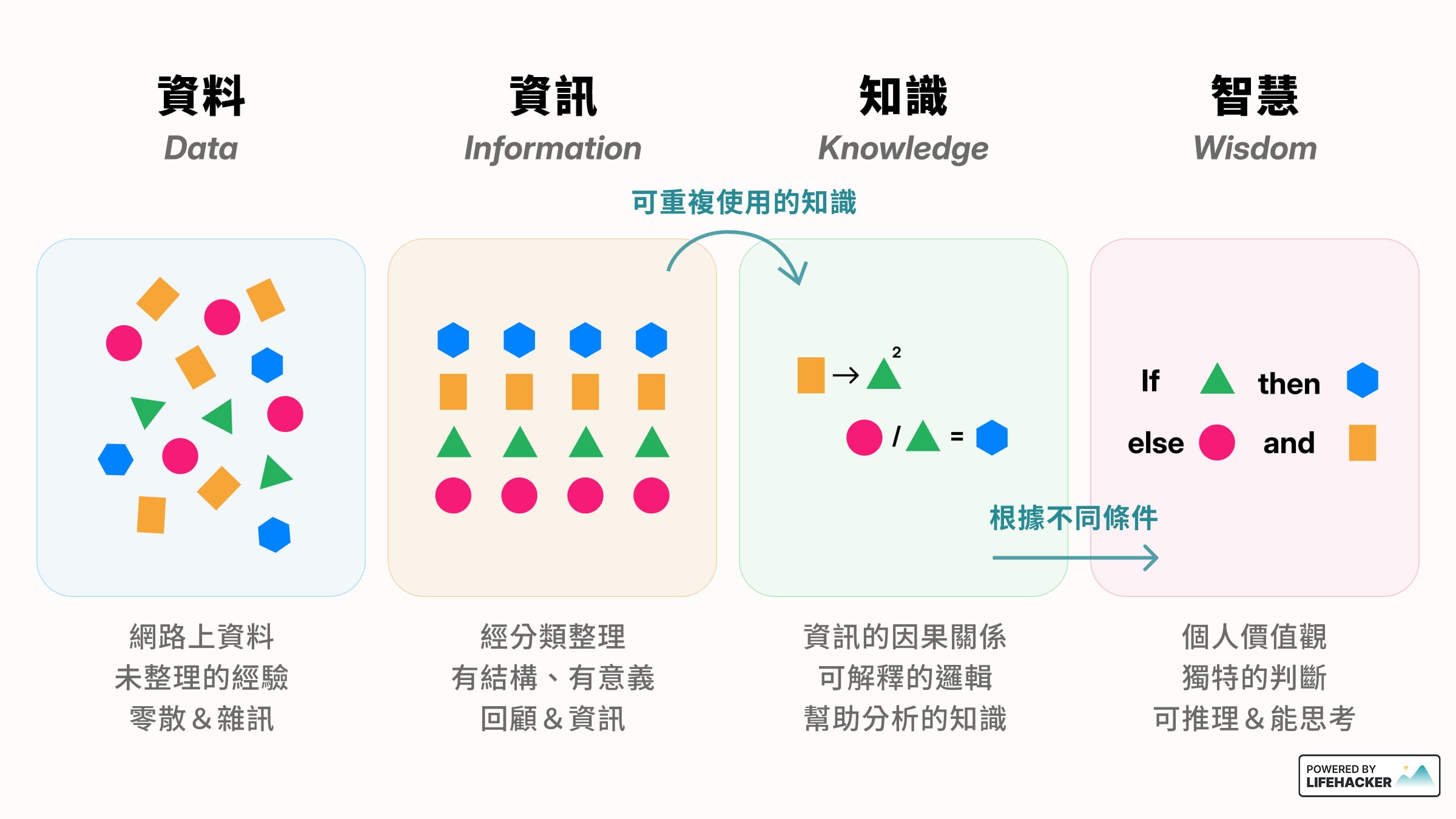
Raymond’s explanation
DIKW is one of the models Raymond discusses most often in his courses because it precisely describes how experience becomes capability.
Imagine the brain as an alchemy factory:
- Data: Ore piled up at the factory entrance—calendar entries, notes, chat records, and the small and large events experienced each day. If they are simply piled up, they are only noise and have no value.
- Information: Put the ore through a sorting machine. Thinking frameworks such as problem analysis turn scattered data into meaningful elements. For example, noticing that “three projects were delayed last week, all at the same stage” is an upgrade from Data to Information.
- Knowledge: Refine the sorted material into metal by finding causal relationships and generalizing reusable principles. For example, “align across departments in a document before meeting, and efficiency triples” is Knowledge.
- Wisdom: Forge the metal into a tool of one’s own by internalizing general knowledge as a personal methodology and knowing when to persist and when to compromise. This is not memorizing someone else’s framework; it is “your version.”
Every effective review completes a full transformation from Data to Wisdom.
For many people, three years of work differs from one year only in repeating the same experience three times, rather than truly accumulating three years of capability. The difference is whether they have completed this D→I→K→W path.
Origin
Russell Ackoff systematized the model in “From Data to Wisdom” in 1989. It was later widely applied in knowledge management. Raymond reinterpreted it as a practical framework for personal growth in The Super Individual’s Way of Working course.
Raymond’s application
| Level | Description in the diagram | Correspondence in the system |
|---|---|---|
| Data | Scattered and noisy; unprocessed experiences of “others” | Highlights, memorable quotes from others |
| Information | Stories, cases, and reflections made structured and meaningful through personal thinking and organization | Raymond’s social-media posts, distilled notes, original course-script passages, WordPress blog, and Raymond’s YouTube interviews |
| Knowledge | Causal relationships, explainable logical processes, reusable knowledge | Knowledge layer of concept pages (Knowledge Cards), Raymond’s methodologies (TRIRO, Super Individual framework) |
| Wisdom | Personal values and unique judgment | Wisdom layer of concept pages, Raymond’s philosophical thought, values, and interpretation |
Where it has been discussed
Course scripts
- 21 | Effective Review (Part 1): The Secret to 10x Growth — full DIKW model lesson, with diagram
- 12 | How to Use the Beginner’s Mind? The Feynman Learning Technique_ — “Only by adding other people’s ideas to one’s own thinking can they become unique knowledge and personal wisdom”
Related concept pages
- Learning Methods — DIKW as a core learning strategy
- Retrospectives — the four-level transformation in review
- Second Brain — DIKW as a knowledge-layering framework
Related concepts
Learning Methods, Retrospectives, The Capability Compound-Interest Flywheel